



The Evolving Protection Landscape: How the Emerging Asian Middle Class views AI, Affordability and Mobility

Senior Vice President, Economist
A Synopsis of insights from Peak Re’s 2026 Emerging Asia Middle Class Consumer Survey
Introduction
Over the five years that Peak Re has conducted the Emerging Asia Middle Class Consumer Survey, the economic and protection landscape for consumers has shifted significantly—from pandemic recovery to rising inflation, geopolitical conflicts and the emergence of new technologies such as AI.
Amid these changes, our findings show that optimism among the Emerging Asian middle class endures: a majority remain optimistic about their local economy, their social mobility and their children’s future. At the same time, the middle-class consumers’ perception of risks has broadened. Concerns have increased across economic, health, geopolitical, climate and technological dimensions. In 2026, consumers rated long-term financial security, physical health and affordability as their top three concerns.
This year’s survey[1] explores the views of Emerging Asian middle class on AI, particularly in the insurance purchase and claims journey, electric vehicles and autonomous driving, and how they are adapting to rising cost-of-living pressures—especially those arising from medical inflation and rising health premiums.
The following are the key findings from the survey.
The AI ‘Trust Ceiling’[2]
Generative AI use is becoming mainstream: more than 80% of middle-class consumers use it weekly, both personally and at work. They are turning to AI for purchase decisions, healthcare and mental health support, financial advice and insurance recommendations.
A key finding of the survey is an AI trust ceiling: consumers trust AI for gathering and paraphrasing information, but trust is lower in using AI for decision-making, particularly for more consequential decisions. Reflecting this caution, 60% of consumers identify themselves as AI “verifiers”, using AI as a starting point for information, then validating its outputs through other search modes or with professionals.
In the insurance purchase journey, a majority are using AI to compare prices and benefits and understand policies. However, when it comes to selecting and purchasing a policy—52% expressed a strong preference for human agents’ advice, as opposed to 12% who strongly prefer AI advice.
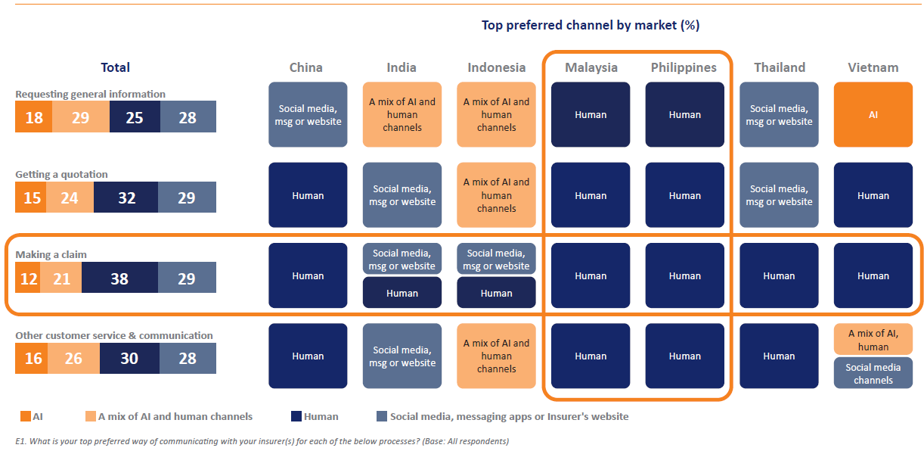
A similar divide is seen in how consumers want to interact with insurers. They are relatively more comfortable with AI interfaces for lower-stakes, information-led tasks, such as requesting general information, obtaining a personalised quote or accessing customer service. But claims handling is where consumers clearly prefer a human touchpoint, across different markets (see Figure 1).
Overall, consumers are worried about data privacy, AI errors and reduced human touch as the top risks associated with AI in insurance. For re/insurers, this has implications for how AI is deployed in processes, to support efficiency and convenience, but without compromising trust.
Figure 1: Preference for AI/Human communicating with insurers (%)
Source: Peak Re Consumer Survey 2026
Generative AI’s influence on claims filing
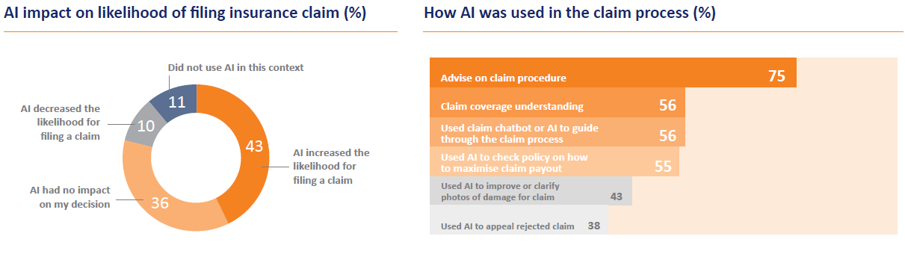
AI also influences consumers’ willingness to file claims. 43% of those who filed or considered filing a claim in the past 12 months said that generative AI increased their likelihood of filing a claim. This compares with 10% who said AI decreased their likelihood, while another 36% reported no impact (see Figure 2).
Our findings suggest that generative AI may make claim filing feel more manageable for consumers by reducing the perceived effort and uncertainty around the process.
Consumers are turning to AI for advice on claims procedures (75%), followed by understanding policy coverage (56%), and seeking an opinion on the likelihood of a claim payout (55%) (see Figure 2).
This matters because our past survey[3] showed that about 40% of consumers did not file claims when they felt the process was “too complex” or “not worth the effort”, or when the uncertainty about payouts discouraged them. By making the process easier to navigate, AI may help lower some of these barriers.
Figure 2: AI impact on likelihood of filing claims, and how AI was used by consumers in the claim process (%)
Source: Peak Re Consumer Survey 2026
Learning to cope with medical inflation
Medical inflation is a pressure point for consumers and insurers alike. Our findings suggest that consumers are trying to adapt to rising medical costs without disengaging from health insurance, as premiums rise.
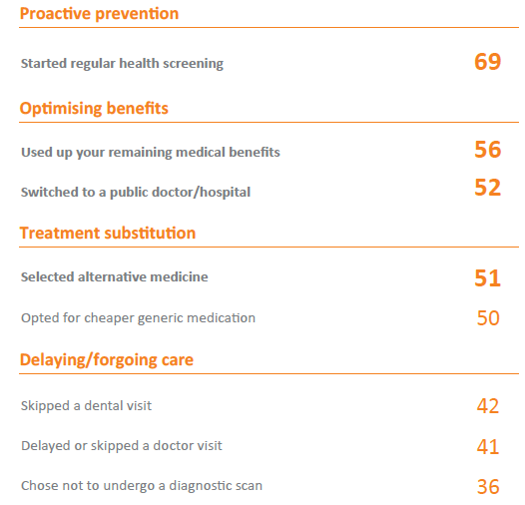
Across markets, consumers are taking proactive preventative health measures, such as regular health screenings, in response to rising medical costs (see Figure 3). In some markets, consumers are also switching to public health systems or choosing cheaper generic medication, as additional coping mechanisms. Encouragingly, foregoing or delaying care, such as dental treatment or doctor visits, were among the less commonly reported responses to rising costs.
So, what are consumers looking for from insurers?
The survey shows that amid rising premiums, 22% of middle-class consumers in Emerging Asia rank added-benefits such as preventative care packages in health insurance as their top choice, ahead of cost-sharing features such as deductibles/co-pay (14%) or fixed-benefit cover (15%).
Figure 3: Actions consumers have taken in the past to reduce medical costs (%)
Source: Peak Re Consumer Survey 2026
Mobility in transition: New questions on insurance costs and safety
Consumer mobility is undergoing a shift. The survey shows that in Emerging Asia, purchase intent for electric vehicles (EVs) is on par with that for traditional combustion-engine cars.
However, consumers remain uncertain about how EV insurance premiums compare with those for traditional cars. Their views are similarly mixed on safety and repair costs.
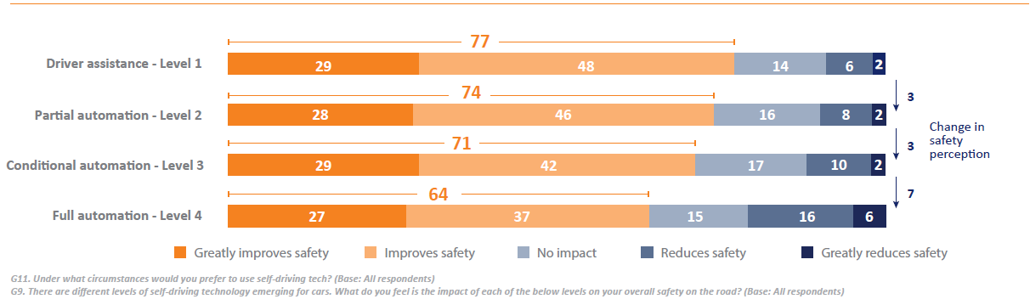
The survey also covered autonomous driving. Here, as in the case of AI, automation is welcome, but trusted only up to a point. Consumers prefer driving-assistance features such as automatic parking and highway driving, but trust in safety declines for full automation (see Figure 4).
Consumers also do not expect self-driving features that improve safety to reduce insurance premiums, as they believe any benefits from fewer crashes may be offset by higher repair costs.
For re/insurers, we believe there is an opportunity to improve consumer understanding of EV and automation-related insurance pricing, risks, and coverage options, through clear communication on consumers’ evolving mobility needs.
Figure 4: Perceived impact of automation on safety, by levels of automation (%)
Source: Peak Re Consumer Survey 2026
Conclusion
The survey points to a middle class that is adapting to the pressures of inflation and the growing role of technology in the protection landscape.
Consumers value AI and driving automation where these technologies can help reduce effort or improve access to information, but remain cautious about their use for decision-making, especially for consequential decisions. In insurance policy selection and claims handling, human judgement remains highly valued, while consumer concerns centre around data privacy, AI errors and reduced human touch. Consumers are also adapting to rising medical costs by taking preventative measures and are favouring added-benefits in their health policies, over greater cost-sharing.
For the insurance industry, the findings of the survey highlight two priorities: deploying technology in ways that can reduce friction without compromising trust; and understanding how consumers are defining value amid rising costs and affordability pressures. The findings also point to an opportunity for re/insurers to help consumers better understand the risks, coverage and insurance implications of emerging technologies.
Disclaimer
Peak Re provides the information contained in this document for general information purposes only. No representation or guarantee is made as to the accuracy, completeness, reasonableness or suitability of this information or any other linked information presented, referenced or implied. All critical information should be independently verified and Peak Re accepts no responsibility or liability for any loss arising or which may arise from reliance on the information provided. All information and/or data contained in this document is provided as of the date of this document and is subject to change without notice. Neither Peak Re nor any of its affiliates accepts any responsibility or liability for any loss caused or occasioned to any person acting or refraining from acting on the basis of any statement, fact, text, graphic, figure or expression of belief contained in this document or communication.
The information is not intended to constitute, and should not be construed as, investment research, financial advice ( nor investment, tax, accounting or legal advice), or a recommendation of any kind.
All rights reserved. The information contained in this document is for your information only and no part of this document may be reproduced, stored or transmitted in any form or by any means, electronic, mechanical, photocopying, recording or otherwise, without the prior written permission of Peak Re. Any other information relating to this document, whether verbal, written or in any other form, given by Peak Re either before or after your receipt of this document shall be provided on the same basis as set out in this disclaimer. This document is not intended to constitute advice or recommendation, and should not be relied upon or treated as a substitute for advice or recommendation appropriate to any particular circumstances.
© 2026 Peak Reinsurance Company Limited.
[1] The 2026 survey was conducted by Intuit Research between 6 May to 19 June, 2026, and included over 8000 respondents across seven Emerging Asian economies (as defined by the International Monetary Fund (IMF)), including China, India, Indonesia, Malaysia, the Philippines, Thailand and Vietnam. The middle class is defined for this study as any household with an income between 2/3 and 3x the local median household income. For India, the upper limit is taken at 4x to avoid excluding too many consumers.
[2] The survey tested respondent opinions only for generative AI use. Use of AI in the insurance journey refers exclusively to direct, intentional consumer usage of Generative AI (GenAI) (e.g., active user prompting for research or advice). It excludes backend or implicit AI capabilities integrated into platforms, such as automated recommendation engines or data consolidation on insurance aggregator sites.
[3] Peak Re Consumer Survey 2024: Unlocking Potential: Asia’s Middle-Class Women and Old Age Care
Other Insights

Mon, 21 Sept 2026
| 1 min
|
Victor Kuk

Fri, 18 Sept 2026
| 10 mins
|
Philip Hough

Thu, 10 Sept 2026
| 5 mins
|
Philip Hough

Wed, 9 Sept 2026
| 5 mins
|
Sudhir Salian

Tue, 8 Sept 2026
| 1 min
|
Victor Kuk
Elevate Your Business
with Peak Re
with Peak Re